





 MX-DREAM
  March 3, 2026
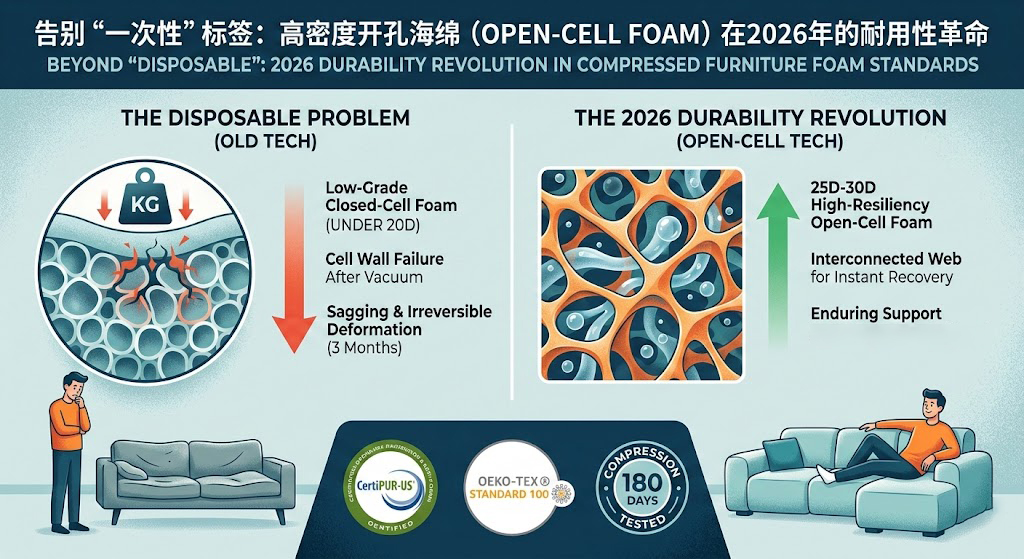
For years, the B2B furniture industry viewed "compressed foam" as a logistical win but a durability nightmare. Overseas buyers and e-commerce retailers often battled the "disposable" stigma: sofas that never fully decompressed or cushions that sagged after just a few months of use.
As we enter 2026, a material science breakthrough is shifting the paradigm. High-Density (HD) Open-Cell Foam is no longer just a padding material; it is a high-performance structural core designed for longevity, export-ready logistics, and premium comfort.
To solve the problem of sagging, we must understand why traditional foam fails. Low-grade foams (under 20D) rely on thin-walled "closed cells" that act like tiny, fragile balloons.
Compression Damage: Long-term vacuum packaging (3-6 months) ruptures these cell walls. Once broken, the foam loses its "memory" and fails to regain its original shape upon unboxing.
Mechanical Fatigue: Low-density foam lacks the polymer mass to resist repeated loading, leading to the dreaded "center-sink" after 1,000 sitting cycles.
In the current B2B landscape, "Density" (D = kg/m3) is the primary metric for quality. In 2026, the industry has standardized the 25D-30D range as the "Performance Tier" for professional-grade compressed furniture.
Ideal for accent chairs, modular sofa backrests, and children's furniture.
The Benefit: Offers excellent recovery after vacuum compression. It’s light enough to keep "Last Mile" shipping costs low while providing enough structural integrity to avoid bottoming out.
The preferred choice for primary living room sofas and high-traffic commercial seating.
The Benefit: With a density of 30kg/m³, this foam passes rigorous fatigue tests with less than 4% height loss after 30,000 cycles. It provides the "firm-yet-plush" feel that high-end consumers demand, even after 6 months in a shipping container.
The true revolution of 2026 is Open-Cell Architecture. Unlike traditional foam, open-cell foam acts like a 3D interconnected web rather than a collection of sealed bubbles.
Instant Recovery: Air flows freely through the material. When a customer unboxes a vacuum-packed sofa, it snaps back to 98% of its volume within 24 hours.
Thermal Regulation: One of the biggest consumer complaints is "sleeping hot." Open-cell foam dissipates heat 35% more efficiently than closed-cell alternatives, a massive selling point for warm-climate markets like Australia and the Southern US.
Anti-Microbial Properties: Improved airflow prevents moisture buildup, making it the ideal choice for long-distance maritime shipping.
Compressed foam furniture is no longer a "cheap" alternative. By leveraging 25D-30D Open-Cell technology, B2B buyers can offer products that combine the shipping efficiency of a parcel with the durability of a traditional sofa.
Lower return rates, higher customer satisfaction, and optimized container loads—this is how you win the 2026 furniture market.

May we help you?Request quote

 Thanks for Subcribing





© 2025, www.mx-dream.com All rights reserved.